
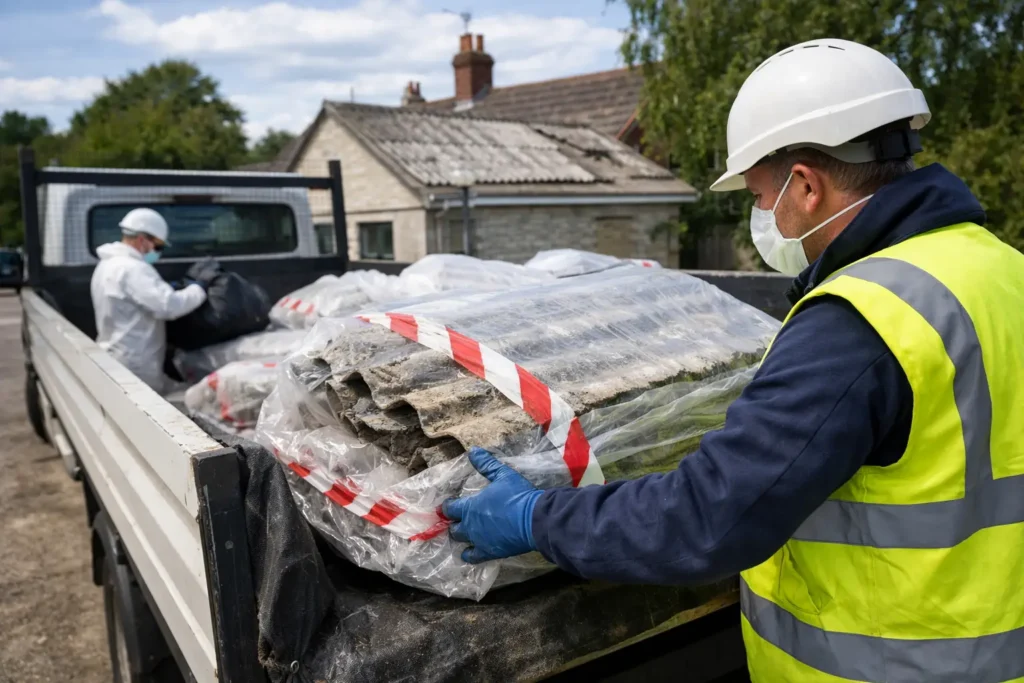
A few broken garage-roof sheets may look like a small rubbish-removal job, but asbestos is hazardous waste. It cannot go in a household skip, be taken to a normal tip or be left for a general builder to collect. So, how much does asbestos disposal cost? For most customers, the answer depends on the material, its condition, the quantity and the controls needed to remove it safely.
The disposal charge at an authorised facility is only one part of the final price. A proper quote should also allow for assessment, safe removal, protective equipment, containment where needed, sealed packaging, transport and the paperwork that confirms the waste has been handled correctly. That end-to-end approach protects the property, the people around it and your peace of mind.
Typical asbestos disposal costs
As a broad guide, a small, straightforward collection of securely wrapped asbestos cement waste may cost from around £150 to £300. This can suit a limited number of sheets, a small section of downpipe or similar low-volume material that is accessible and ready for collection.
Where removal is required, costs rise because the contractor must make the material safe before it can be transported. Removing and disposing of a small asbestos cement garage roof commonly starts at around £600 and may range to £1,500 or more, depending on size, access and whether the garage also needs demolishing. Larger garages, outbuildings and commercial roofs will need an individual quotation.
For internal materials, the range is wider. Small areas of asbestos floor tiles or textured coatings may cost several hundred pounds, while pipe insulation, damaged boards or friable materials can require more extensive control measures and therefore a higher price. Sampling or a survey may be the sensible first cost where the material has not yet been identified.
These figures are useful for budgeting, not a substitute for a site-specific estimate. The safest way to get an accurate price is to send clear photographs and dimensions, then arrange an inspection where the material, condition or access is uncertain.
What affects how much asbestos disposal costs?
The biggest factor is the type of asbestos-containing material. Asbestos cement roof sheets, gutters and downpipes are generally more stable when intact than insulation, lagging, loose-fill material or damaged asbestos insulating board. Stable material can still release fibres if cut, drilled, snapped or handled carelessly, but its removal process may be more straightforward than work involving more easily disturbed materials.
Condition matters just as much. An intact garage roof with good access is very different from sheets that have broken during a storm or have been piled in a confined rear garden. Damaged material needs careful handling to prevent further breakage, and contaminated debris may need to be collected as part of the job.
Quantity and size affect both labour and disposal fees. A single flue section is not priced like a full double-garage roof. However, very small jobs can still have a minimum charge because trained operatives, specialist packaging, safe transport and waste documentation are required regardless of volume.
Access is another practical consideration. A clear driveway, ground-level roof and room to work safely can reduce time on site. Restricted alleyways, upper-floor locations, shared access, parked vehicles, fragile roofs or a property in a busy town centre may require additional planning. For commercial premises, work may need to be timed around staff, customers or tenants to keep disruption low.
Finally, the quote will reflect the level of site control needed. Some work can be completed efficiently with carefully controlled methods and localised protection. Other jobs need a fully enclosed working area, specialist decontamination arrangements, air management and a more detailed plan of work. The right method is determined by risk, not by choosing the cheapest option.
Disposal-only versus a full removal service
It is useful to separate disposal from removal when comparing prices. Disposal-only means the asbestos waste has already been safely prepared for collection and can be accepted for transport. This is not an invitation to remove suspected asbestos yourself. Disturbing unknown materials can create avoidable risk and may turn a simple job into a more expensive clean-up.
A full removal service is usually the better option when asbestos is still fixed to a roof, ceiling, floor, pipework or wall. It covers the safe process from the first assessment through to final disposal. The team plans the work, protects the surrounding area, removes the material with appropriate controls, packages it securely and transports it to an authorised hazardous-waste facility.
For homeowners, landlords and property managers, this avoids the uncertainty of trying to arrange separate trades, transport and disposal. It also provides a clear record that the waste has been dealt with responsibly. If you are preparing a property for sale, refurbishment or demolition, that record can be particularly valuable.
Why cheap asbestos disposal can cost more later
A low price is only good value if the work is completed safely and the waste reaches the correct disposal route. Be cautious of cash-only offers, vague descriptions of what is included or anyone proposing to break sheets up to fit them into a vehicle. Asbestos waste must be kept controlled throughout the job, not simply taken away quickly.
An incomplete quote can also cause problems. One contractor may appear cheaper because it excludes removal, packaging, transport, disposal charges, cleaning or paperwork. Ask what the price covers and whether there could be additional costs if the material is damaged, harder to access than expected or different from the original description.
A dependable quote should explain the scope in plain language. You should know what material is being removed, which areas will be protected, how waste will be contained and what happens once the work is complete. Clear communication matters as much as the final figure when hazardous materials are involved.
When testing or a survey should come first
Not every old board, tile, ceiling coating or corrugated sheet contains asbestos. Age and appearance alone cannot provide certainty. If a material is due to be disturbed during renovation, repair or demolition, sampling is often the quickest way to establish what you are dealing with.
A survey may be more appropriate for larger properties, commercial buildings or projects involving several trades. It helps identify asbestos-containing materials before works begin, so removal can be planned properly rather than discovered halfway through a refurbishment. This can save time, prevent delays and give contractors the information they need to work safely.
For landlords and business owners, early identification also supports your wider responsibility to manage asbestos risks within the property. It is usually far easier to organise a controlled removal before works start than to stop a project after suspect material has been disturbed.
Getting an accurate quote without delay
Photographs can make the first assessment much faster. Take images from a safe distance and include wider shots showing the size of the area, access routes and any visible damage. Do not climb onto a roof, move debris, scrape a ceiling or break off a sample to improve the picture.
It also helps to provide the property location, approximate measurements, the material’s position and whether work is planned nearby. A garage roof in Durham, an Artex ceiling in York or floor tiles in a Middlesbrough shop may all need different access and scheduling arrangements, even where the material itself is similar.
North East Asbestos Removal can assess the information, provide a free estimate and advise whether photographs are enough for an initial quote or whether testing or a visit is needed. The aim is not to make the job sound complicated. It is to get the job done right, with the correct safety measures and no surprises over what is included.
If you suspect asbestos, leave it undisturbed and ask for professional advice before starting any work. A clear, properly scoped quote is the first step towards making the issue safe, contained and straightforward to resolve.