
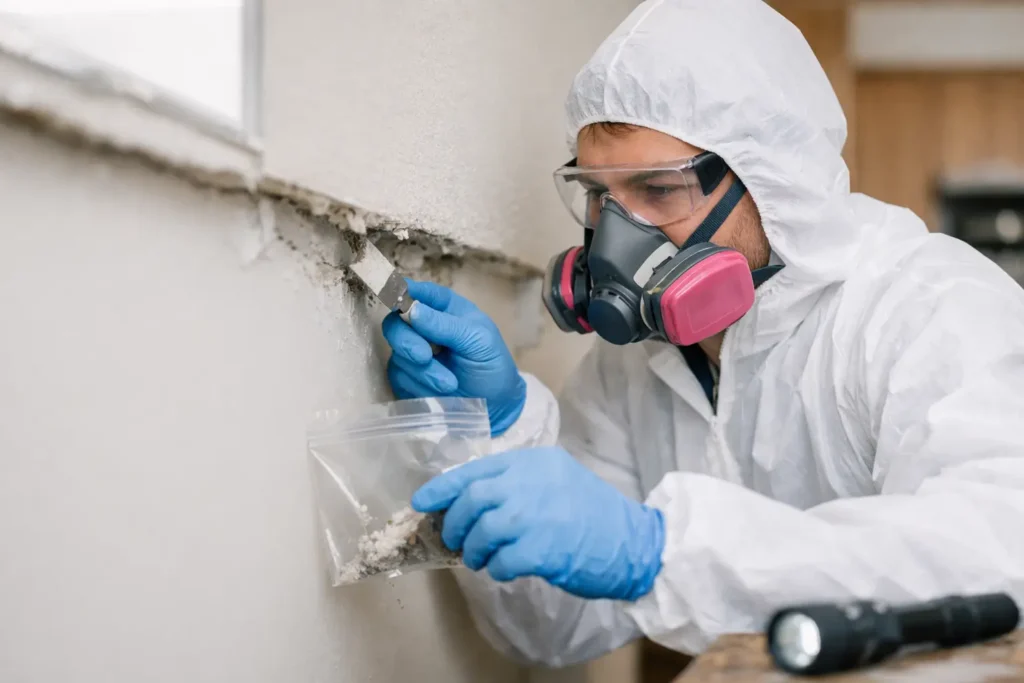
A crack in an Artex ceiling, ageing floor tiles or a corrugated garage roof can stop a renovation in its tracks. The practical question is what happens during asbestos sampling, and whether the process will create disruption or risk. Done properly, it is a small, controlled task that gives you clear evidence before any repair, removal or demolition work begins.
Sampling is not the same as removing asbestos. A trained specialist takes a small, representative piece of suspect material, makes the area safe afterwards and sends the sample for laboratory analysis. The result helps you make the right decision without guessing based on appearance alone.
What happens during asbestos sampling at a property?
The process begins before anyone takes a sample. A specialist will ask where the material is, what work is planned and whether it has been damaged or disturbed. Photographs can be useful for an initial assessment and quote, particularly for garage roofs, ceiling finishes and pipe coverings, but a photograph cannot confirm whether a material contains asbestos.
Properties built or refurbished before 2000 can contain asbestos in a wide range of products. It may be found in cement sheets, textured coatings, insulation boards, floor tiles, pipe insulation, soffits, panels and electrical backing boards. Materials that look alike can have very different compositions, so laboratory testing is the reliable way to confirm what is present.
1. A site assessment comes first
On arrival, the surveyor identifies the material to be sampled and checks its condition, location and accessibility. They will consider who uses the area, whether nearby surfaces could be affected and how the sample can be taken with the least possible disturbance.
A loose, damaged pipe covering needs a different approach from a solid asbestos cement panel on an outdoor garage. Where a material is too friable, heavily damaged or unsafe to access, the right course may be to restrict access and treat it as presumed asbestos until a suitable plan is in place. Sampling should reduce uncertainty, not introduce unnecessary risk.
The immediate area may be kept clear while the work is carried out. For a small domestic sample this is usually brief, but the controls depend on the material, the condition it is in and the location. A kitchen ceiling, communal hallway and commercial plant room each call for a different level of planning.
2. The sample is taken in a controlled way
The specialist uses suitable protective equipment and controlled methods for the task. The aim is to obtain only the amount needed for analysis, without breaking up a larger area than necessary. Depending on the material, this can involve carefully dampening the surface, using hand tools and taking a small section from a discreet but representative point.
The sample must represent the material in question. A ceiling coating may have several layers, for example, while old floor tiles can vary between rooms or later alterations. If visibly different materials are present, more than one sample may be required. Taking one sample from a single location does not automatically confirm the status of every similar-looking surface in the building.
Once the piece has been removed, the sampling point is sealed or repaired as appropriate. The work area is then cleaned using methods suited to the task, such as careful damp wiping or a specialist H-class vacuum. This is why homeowners and tradespeople should not cut, drill, sand or snap off their own sample. A small piece taken carelessly can create avoidable contamination.
3. The sample is sealed, labelled and sent for testing
Each sample is placed into secure packaging, labelled with a unique reference and recorded against its exact location. Good records matter. They allow the laboratory result to be matched to the right material, whether that is a garage roof sheet, a boiler cupboard panel or ceiling texture in a particular room.
The sample is then sent to a laboratory for analysis. The laboratory examines it to determine whether asbestos fibres are present and, where identified, the type of asbestos. Results are normally returned in a written report that records the sample reference, material description, location and finding.
A negative result means that particular sample did not contain asbestos. It does not confirm that every material in the property is asbestos-free, especially where there are separate areas, different product types or previous refurbishments. A positive result provides the information needed to manage the material safely and plan any work correctly.
What your asbestos sampling result means
If asbestos is identified, removal is not always the immediate answer. The right action depends on the material’s condition, how easily it could be damaged, whether it is accessible and what work you intend to carry out nearby. Sound material in a low-risk location may sometimes be left in place and managed, while damaged material or material affected by planned building work may need professional removal.
For example, intact asbestos cement sheeting on an undisturbed outbuilding may present a different level of concern from damaged insulation around old pipework. The type of asbestos is relevant, but it is not the only factor. The potential for fibres to be released is what shapes the practical next step.
If removal is needed, the sampling report supports a proper risk assessment and method statement. The work can then be planned around access, enclosure requirements, protection of occupants, waste handling and final disposal. Some asbestos work carries additional legal controls and notification requirements, so accurate identification at the start prevents costly delays later.
For landlords, property managers and business owners, the report also provides evidence that decisions have been based on competent assessment rather than assumption. That is useful when arranging maintenance, managing contractors or meeting duties to people who use the premises.
Sampling, surveys and air testing are different services
These terms are often used interchangeably, but they answer different questions. Asbestos sampling identifies whether a specific material contains asbestos. An asbestos survey looks more widely at a property, locating and assessing materials that may be disturbed during normal use, refurbishment or demolition.
Air testing measures fibres in the air at the time of the test. It does not identify whether a particular ceiling, tile or board contains asbestos. Air monitoring may be appropriate during certain higher-risk works or as part of clearance procedures, but it is not a substitute for material sampling.
The service you need depends on the job ahead. If you have one suspicious panel or roof sheet, targeted sampling may be enough. If you are buying an older commercial unit, refurbishing several rooms or demolishing a garage, a wider survey is often the more sensible starting point. Clear information at this stage can keep a project moving and protect the people carrying it out.
How to prepare before a specialist attends
Until the material has been assessed, leave it alone. Avoid drilling, sweeping debris, moving broken pieces or using power tools nearby. If the material is visibly damaged, keep people away from the immediate area where possible and do not attempt to cover it with tape, paint or sealant without advice.
It helps to tell the specialist about planned work, recent damage and any access issues before the visit. If a loft hatch, garage or service cupboard needs to be opened, make the route clear and let the team know about pets, occupants or business operations that may need to be considered. This allows the sample to be taken efficiently and with minimal disruption.
If you are concerned about a suspect material at a home or premises in the North East or Yorkshire, North East Asbestos Removal can assess the situation, explain the suitable next step and provide a clear estimate. A small sample taken professionally can replace uncertainty with a safe, workable plan for the job ahead.