
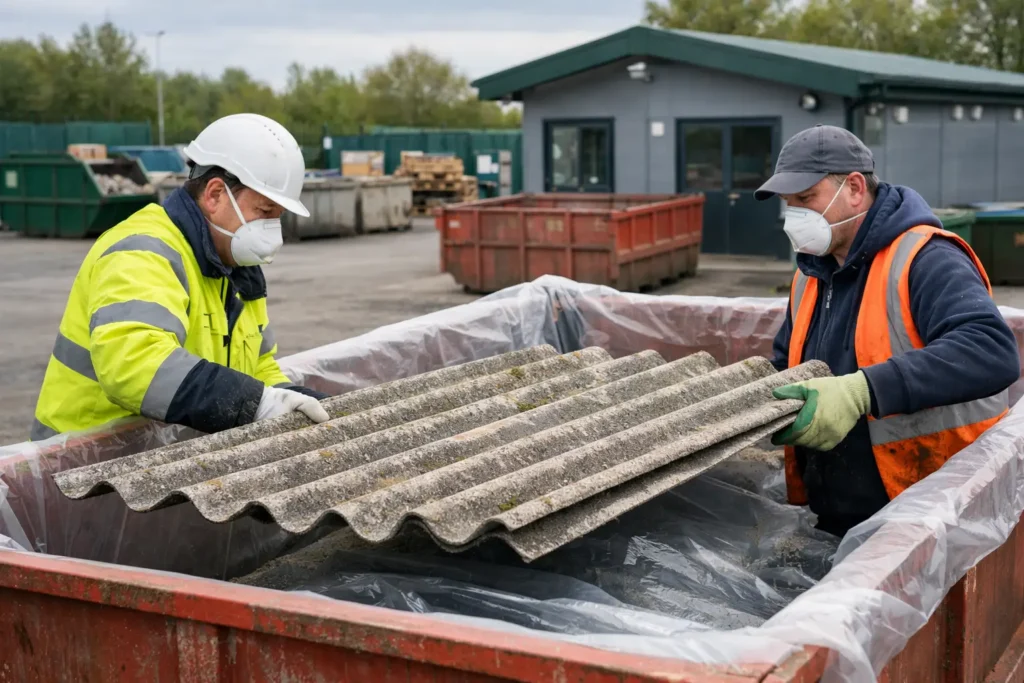
A garage roof starts to leak, a shed is coming down, or renovation work uncovers old corrugated panels. The immediate question is often: where can I dispose of asbestos sheets? The short answer is at an authorised facility that accepts asbestos waste, using a safe collection and transport process. The route is not the ordinary household bin, a skip, or a general waste recycling centre unless that site specifically accepts pre-booked asbestos waste.
Asbestos sheets need careful handling long before they reach a disposal site. Breaking, drilling, dragging or dropping them can release fibres, especially where sheets are weathered or damaged. A specialist removal service keeps the job controlled from assessment through to final disposal, giving you a clear record that the waste has been dealt with correctly.
Where can I dispose of asbestos sheets legally?
Asbestos-containing sheets must go to a permitted hazardous-waste facility that is approved to receive the specific type of asbestos waste. In practice, this is usually arranged through a professional asbestos contractor, which removes the uncertainty around accepted materials, packaging, transport and booking requirements.
Some local authority household waste recycling centres accept small quantities of bonded asbestos cement from residents. However, this varies significantly by council and site. Many centres do not accept it at all; others require advance booking, strict quantity limits, double-wrapping to a specified standard, proof of address, and a particular unloading procedure. They may also refuse loose, broken, contaminated or incorrectly packaged sheets.
Before relying on a recycling centre, check its current asbestos policy directly. Do not assume that a centre accepting plasterboard, roofing felt or ordinary DIY waste can take asbestos. Turning up without confirmation can leave you with hazardous material still on site or in a vehicle, creating a problem that is best avoided.
For landlords, businesses and tradespeople, professional collection is generally the more dependable route. Commercial asbestos waste has additional duty-of-care requirements, and the waste needs to be transported and deposited through the right channels.
Why asbestos sheets cannot go in a normal skip
A general skip is designed for mixed construction waste, not asbestos. Once asbestos enters a skip, it can contaminate other materials and put skip drivers, sorting staff and anyone working nearby at risk. Most skip companies explicitly prohibit asbestos unless a separate, agreed hazardous-waste service has been arranged.
The same applies to kerbside bins, fly-tipping sites, bonfires and household recycling. Burning asbestos does not make it safe. It can instead spread fibres through the air and leave contaminated ash behind. Illegal disposal can also lead to investigation, clean-up costs and enforcement action.
The safest approach is to keep sheets where they are until a competent removal plan is in place. If the material has already been removed and is sitting in a garden or garage, keep people away from it, do not move it again unnecessarily, and arrange advice promptly.
First, establish whether the sheets contain asbestos
Many older garages, sheds, outbuildings and lean-tos have corrugated cement sheets that contain asbestos. Their appearance alone cannot confirm this. Grey, white or weathered corrugated panels are common, but similar-looking non-asbestos products have also been used over the years.
Age and location can provide clues, but testing is the reliable way to identify a material. A sample can be taken safely and analysed so that the next step is based on evidence rather than guesswork. This matters because different asbestos materials and conditions call for different controls.
Asbestos cement sheets are often classed as bonded material, meaning the fibres are held within a cement matrix. When sheets remain intact and undisturbed, the immediate risk can be lower than with loose insulation or damaged board. That does not mean they are suitable for ordinary disposal. Their condition changes the risk: a brittle garage roof with broken edges, lichen growth and previous repair holes needs more careful planning than sound sheets being removed in one piece.
What safe asbestos-sheet disposal looks like
A proper service starts with understanding the material, its condition, access and the reason for removal. For example, a detached garage with clear driveway access is very different from sheets above a narrow shared alleyway or beside a neighbour’s garden. The method should reflect that reality, not force a one-size-fits-all solution.
The work area is prepared to prevent unnecessary disturbance and to protect the surrounding property. Operatives use suitable personal protective equipment and controlled removal techniques, taking care to avoid snapping sheets or creating dust. Where required, work is carried out within a fully enclosed working area so that the removal remains contained and the site stays as clean as possible.
Once removed, the sheets are packaged securely for hazardous-waste transport. They are then taken by an authorised route to an appropriate disposal facility. Documentation is retained where required, providing evidence that the waste has not simply been moved elsewhere.
This end-to-end approach is particularly useful where a garage is being demolished. Roof sheets, wall panels, guttering, downpipes, fixings and debris can all need separate assessment. Removing only the visible roof while leaving contaminated fragments in the structure or surrounding ground does not resolve the issue.
Can I take asbestos sheets to the tip myself?
It depends entirely on the policy of the specific household waste recycling centre and the material involved. A site may accept limited quantities of intact asbestos cement from householders, but only under pre-arranged conditions. It may not accept asbestos from landlords, tradespeople or businesses, even when the material came from a domestic property.
Self-delivery also places the responsibility for safe removal, lifting, wrapping and vehicle transport on you. A roof sheet can be awkward, fragile and difficult to contain without damage. If it cracks while being handled, the risk and clean-up requirements increase.
For a single, confirmed asbestos cement item in good condition, a council-approved route may be suitable if you can meet every requirement. For multiple sheets, a leaking garage roof, damaged material, restricted access, or any uncertainty about the product, specialist collection is usually the safer and more practical choice.
Do not disturb sheets while deciding what to do
If you suspect asbestos, avoid cleaning it with a brush, domestic vacuum or pressure washer. Do not drill it to remove screws, cut it into smaller pieces to fit a car, or stack it with other waste. These actions can turn a manageable removal job into a wider contamination issue.
Keep children, pets, tenants and tradespeople away from the area. If contractors are due to carry out roofing, electrical, demolition or renovation work nearby, tell them about the suspected material before they start. That allows the right assessment to happen before anyone disturbs it.
Photographs can often help a specialist make an initial assessment, particularly where the sheets are visible from a safe distance. They do not replace testing where confirmation is needed, but they can help establish likely material type, access arrangements and the likely scale of the work.
Choosing a collection and disposal service
Look for a contractor that can manage more than the collection itself. The useful questions are whether they can arrange sampling if needed, explain the removal method, protect the work area, remove the waste, transport it correctly and confirm its final disposal. Clear answers on scope and price are as valuable as technical knowledge, especially when a property sale, roof repair or demolition date is approaching.
North East Asbestos Removal provides this managed service across the North East and Yorkshire, from initial assessment through controlled removal and disposal. A free estimate based on photographs can often establish the likely work involved and help you plan without delay.
The best time to arrange asbestos-sheet disposal is before the next repair, clearance or demolition task begins. Leave the sheets undisturbed, get the material assessed, and put a safe disposal route in place that protects your property and everyone around it.